
How AI is Changing the Role of the Customer Success Manager
At a recent Customer Success event in Vancouver, BC, Daphne Costa Lopez, Global Director of Customer Success at HubSpot, shared how AI is rapidly shifting the role of enterprise CSMs. As a sponsor of this event, we wanted to share her learnings.
Daphne states AI is changing the operational core of Customer Success by handling support, answering questions, automating workflows, and even surfacing some risks. As a result, the role of the CSM is moving up the value chain.
The takeaway is clear: The CSM of today is a relationship manager, strategic advisor and proactive planner.
What’s Changing for CSMs
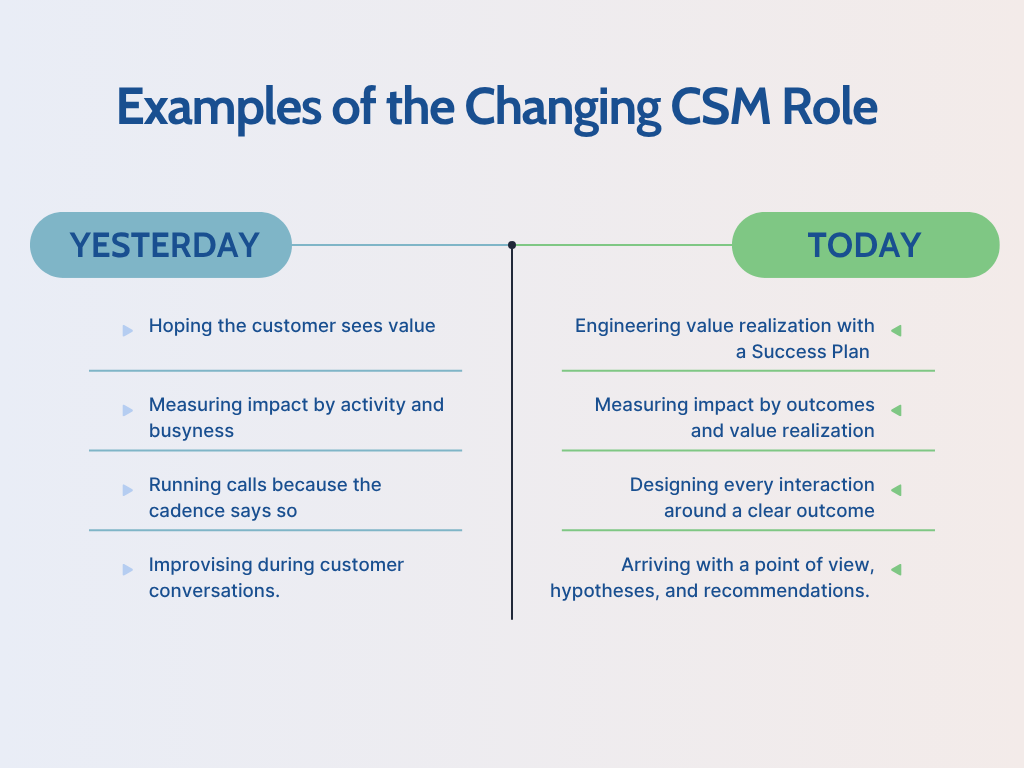
At a high level, this shift shows up in a few important ways (see Daphne’s examples in graphic).
CSMs are no longer primarily measured by calls made, emails sent, and QBRs completed. The metric is shifting to ROI and outcomes.
Their focus is to ensure customers achieve real, measurable value from the product.
AI covers many administrative and transactional tasks. This frees up time but also raises expectations. CSMs are increasingly responsible for higher-order work: influencing stakeholders, navigating internal dynamics, and driving alignment around business goals.
Perhaps most importantly, the role is becoming more human. Success will depend on the ability to build trust, manage complexity, and anticipate risk before it becomes visible in dashboards. Engagement is more about navigating relationships and meeting the specific needs of each customer.
In short, the modern CSM must be proactive, strategic, and deeply attuned to the customer’s world.
How IcebergIQ Supports Today’s CSM
This is where IcebergIQ plays an important supporting role.
Through candid 1-on-1 conversations with your current or former customers, IcebergIQ uncovers the real customer reasons that drive decision making. These are often missed by internal, AI-driven systems which capture the “what” but not the “why.”
These direct conversations give CSMs insight into how their customers define success, where value breaks down, and what shapes renewal thinking.
Equipped with this understanding, CSMs can anticipate risk earlier, tailor their approach to each account, and engage in more proactive, outcome-focused conversations. Instead of reacting to signals, they become strategic advisors for their customers.
The Bottom Line
AI will continue to transform Customer Success, making teams faster, more efficient, and more scalable. But AI can’t deeply understand your customers.
Today’s Customer Success team needs more than data. They need to understand what that data means, and how to respond and react at the right point. And that’s what will enable today’s CSM to truly become a strategic advisor.